Virtual Reality Welding

March 12th, 2010 by Roxy Fuel

I never thought I’d see the day. Let me repeat that – NEVER.

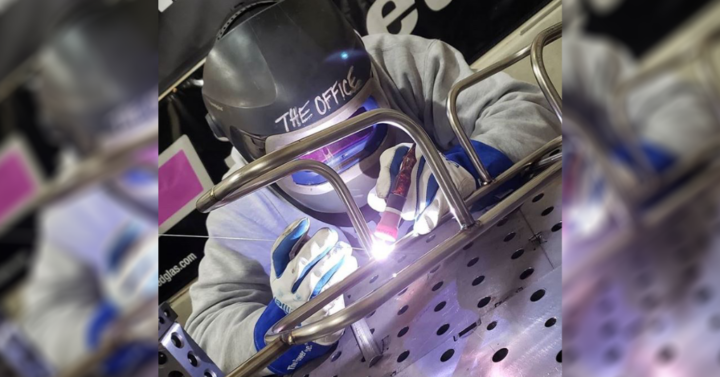
But the day has indeed arrived, from whence forward, a newbie welder will be able to practice welding, not the old-fashioned way, with torch and electrode, but via virtual reality.

You can thank Lincoln Electric for this new advancement in welding technology — they are the producers of the new VRTEX 360 which enables the wearer to weld via a virtual welding gun and a helmet that is equipped with monitors on the inside.

You can “virtually” weld in a welding booth, on a construction site — even on a base in the desert!

And, it has to be said, this is the greenest welding machine on the market, and it will enable students to learn faster than ever before.

Who knows — this newest welding “video game” could become so popular that instructors will have to pry the virtual torch right out of their students’ unwilling hands.

One can only hope.

Bookmark and Share Bookmark/Share this post!


Metal Church

March 11th, 2010 by Roxy Fuel

What are you doing this Sunday?  Planning on going to church?

How about Metal Church, with your favorite preacher, Jesse James?!?

Bookmark and Share Bookmark/Share this post!


VW Bug + Jet Engine = ???

March 10th, 2010 by Roxy Fuel

I got this forwarded to me in an email and immediately knew that we had to post this here on Joe Welder!

Ron Patrick’s Street-Legal Jet Powered Volkswagen Beetle

This is my street-legal jet car on full afterburner.

The car has two engines: the production gasoline engine in the front driving the front wheels and the jet engine in the back.

The idea is that you drive around legally on the gasoline engine and when you want to have some fun, you spin up the jet and get on the burner (you can start the jet while driving along on the gasoline engine).

The car was built because I wanted the wildest street-legal ride possible.

With this project, I was able to use some stuff I learned while getting my fancy engineering degree (I have a PhD in Mechanical Engineering from Stanford University) to design a street-legal jet car without the distraction of how other people have done it in the past – because no one has.

I don’t know how fast the car will go and probably never will. The car was built to thrill me, not kill me. That doesn’t stop me from the occasional blast on the highway though.

CONTINUE READING ONLINE ->

Bookmark and Share Bookmark/Share this post!


A New Kind of Suit

March 9th, 2010 by Roxy Fuel

I’d like to thank Craig Swanson for the following cartoon, which has to be one of the best ones on welding I’ve yet to find:

WeddingSuit.sized

Bookmark and Share Bookmark/Share this post!


Viking Pride

March 8th, 2010 by Roxy Fuel

What did you do this semester?  Clone fruit flies?  Learn about logarithms?

Gary Blazek spent it welding a 500 lb. sculpture of Thor, his school’s mascot.  Now, that’s a project you don’t often hear about!

College mascot recreated in metal

Monday, Dec 07, 2009
By Lynne Lynch
Herald staff writer

MOSES LAKE — His horned helmet reaches the height of the highest bookshelf in Shawn McDaniel’s welding classroom at Big Bend Community College.

doc4b1d80e9847a1745906081The helmet wearer is Thor, a metal statue of the college’s Viking mascot, created by student Gary Blazek. Thor weighs between 450 to 500 pounds and is made of a variety of parts.

Thor was quietly standing in the corner of the classroom last week, just a few days before fall quarter’s end.

His creator, Blazek, 55, was laid off from Genie Industries in February. At the company’s Moses Lake plant, he welded swing units and also worked on a new production line.

He started taking welding classes at the college to improve his pipe welding skills and to make himself more marketable to potential employers.

In October, he responded to instructor McDaniel’s request for students to make items benefiting a student scholarship fund.

Using donated scrap metal from his past employer and a plow disc, he started working on Thor.

CONTINUE READING ONLINE ->

Bookmark and Share Bookmark/Share this post!


Defying Gravity

March 5th, 2010 by Roxy Fuel

Gravity.  It’s simply a fact of life; we can’t change it.  But we may be able to work around it.

Gravity Can Make Welding More Expensive, Learn How to Lower Your Welding Costs

12/28/2009 9:46:00 AM – Article #2909

By Mechanizing the Weld System Using the Proper Positioning Equipment and Multi Wire Welding, Expect a 60 Lb. Weld Deposition per Hour

912289488Gravity makes welding more expensive, it’s a fact.

That is why downhand welding will cost less than vertical or overhead welding.

It’s all about deposition rates.

When welding in the vertical or overhead position, the higher your metal deposition rate, the more likely the weld metal is to sag and run out of the joint.

To combat these problems try using a pulsed power source that produces less heat, or use current and voltage settings that reduce the burn-off rate or use smaller diameter electrodes with good out of position characteristics.

CONTINUE READING ONLINE ->

Bookmark and Share Bookmark/Share this post!


Welding for a Hair Cut

March 4th, 2010 by Roxy Fuel

What would it take for you to cut off all your hair?  A million bucks?  A week’s paid vacation?

How about some welding supplies?

Hair trade: Student donates ponytail in return for contibutions of steel to welding program

BY TRIBUNE STAFF • NOVEMBER 5, 2009

Scott Stekly lost his ponytail Wednesday.

Stekly got a buzz cut from a classmate in the Construction Trades Building, courtesy of Joe Filipowicz, Salvage Manager of Steel Etc.

Scott Stekly, a welding student at MSU-Great Falls, gets a buzz cut by classmate Rachel Kaiser Wednesday in the welding shop. (TRIBUNE PHOTO/ RION SANDERS)

Scott Stekly, a welding student at MSU-Great Falls, gets a buzz cut by classmate Rachel Kaiser Wednesday in the welding shop. (TRIBUNE PHOTO/ RION SANDERS)

Filipowicz’ company agreed to contribute metal to the welding program as an added incentive for the hair loss.

Prior to entering the welding program to pursue a second career, Stekly had been a longtime local cosmetologist, where he met Joe Filipowicz and his father Jimmy, owner of Steel Etc.

When Stekly entered the fall semester, he made a challenge to the Filipowiczes. He would allow them to cut his hair in return for donations of steel materials to the MSU-Great Falls Welding Program. Steel Etc. accepted, and the hair cut was scheduled.

The donated steel will consist of pipe and plate that can be used for the college’s welding students to practice various welds and cuts. After being used by the program, the scrap materials will be returned to Steel Etc., which will recycle the metals, sending them to a steel mill for melting and reprocessing.

Bookmark and Share Bookmark/Share this post!


Standing the Heat

March 3rd, 2010 by Roxy Fuel
An introduction to friction stir welding
By Jeff Defalco, Contributing Writer
September 15, 2009
A relatively new joining process, friction stir welding (FSW) produces no fumes; uses no filler material; and can join aluminum alloys, copper, magnesium, zinc, steels, and titanium. FSW sometimes produces a weld that is stronger than the base material.
Friction stir welding (FSW) is a relatively new joining process that has been used for high production since 1996. Because melting does not occur and joining takes place below the melting temperature of the material, a high-quality weld is created. This characteristic greatly reduces the ill effects of high heat input, including distortion, and eliminates solidification defects. Friction stir welding also is highly efficient, produces no fumes, and uses no filler material, which make this process environmentally friendly.
History
Friction stir welding was invented by The Welding Institute (TWI) in December 1991. TWI filed successfully for patents in Europe, the U.S., Japan, and Australia. TWI then established TWI Group-Sponsored Project 5651,”Development of the New Friction Stir Technique for Welding Aluminum,” in 1992 to further study this technique.
The development project was conducted in three phases. Phase I proved FSW to be a realistic and practical welding technique, while at the same time addressing the welding of 6000 series aluminum alloys. Phase II successfully examined the welding of aerospace and ship aluminum alloys, 2000 and 5000 series, respectively. Process parameter tolerances, metallurgical characteristics, and mechanical properties for these materials were established. Phase III developed pertinent data for further industrialization of FSW.
Since its invention, the process has received world-wide attention, and today FSW is used in research and production in many sectors, including aerospace, automotive, railway, shipbuilding, electronic housings, coolers, heat exchangers, and nuclear waste containers.

“If you can’t stand the heat, get out of the kitchen.”

This expression makes absolutely no sense if you’re in the profession of welding.

#1:  If you can’t stand the heat, why the heck are you a welder?

#2:  There is no kitchen.  What kitchen?  If you’re welding in a kitchen, get out of that kitchen. Right now! There are gas mains!

#3:  If you can stand the heat, and you’re not in a kitchen, then why would you move?  Stand right there!

In fact, let’s add some more heat.  Let’s add some… friction.

That’s right, you heard me. Friction, as in friction stir welding. FSW. It’s all the rage in… in…

Just read.

An introduction to friction stir welding

By Jeff Defalco, Contributing Writer
September 15, 2009

A relatively new joining process, friction stir welding (FSW) produces no fumes; uses no filler material; and can join aluminum alloys, copper, magnesium, zinc, steels, and titanium. FSW sometimes produces a weld that is stronger than the base material.

fsw-cylindrical-shouldered-tool-profiled-probeFriction stir welding (FSW) is a relatively new joining process that has been used for high production since 1996. Because melting does not occur and joining takes place below the melting temperature of the material, a high-quality weld is created. This characteristic greatly reduces the ill effects of high heat input, including distortion, and eliminates solidification defects.

Friction stir welding also is highly efficient, produces no fumes, and uses no filler material, which make this process environmentally friendly.

CONTINUE READING ONLINE ->

Bookmark and Share Bookmark/Share this post!


Some Schoolin’

March 2nd, 2010 by Roxy Fuel
CCC&TI helps students discover their artistic talents
Hidden abilities revealed during classes lead to new careers, art sales and shows.
Posted: Sunday, Sep. 13, 2009

I’ve always had a great respect for teachers, no matter what grade they teach or where their specialty lies.  Teachers have a special job: they prepare us for the real world.  In times like these, the skills and inspiration that teachers offer is more valuable than ever…..

CCC&TI helps students discover their artistic talents

Hidden abilities revealed during classes lead to new careers, art sales and shows.

Posted: Sunday, Sep. 13, 2009

Two students at Caldwell Community College and Technical Institute are finding success with their artistic talent.

betty0913.ART_GKKP1M3L.1+arnold sculpture.JPG.embedded.prod_affiliate.138Michael Arnold discovered a hidden talent and a new career when the demolition company he worked for went out of business. He enrolled at CCC&TI to pursue a GED and signed up for a welding class as well.

“We spent several weeks welding straight lines, and I wanted to try something different,” he said. “So I started welding scrap pieces together just to see what I could make out of them.”

The Granite Falls native created metal sculptures of a horse, a praying mantis, a stork, a reading man, a tree and a 90-pound dragon fly in just a few months. He has sold several pieces and won CCC&TI’s Spring Fling Recycled Art Contest with a mask he created out of scrap metal.

CONTINUE READING ONLINE ->

By JIM COOK
Published: September 15, 2009
A new state grant will help Wallace Community College continue to train workers in welding, a career field that appears to be almost recession proof, according to school officials.
State Sen. Harri Anne Smith, R-Slocomb, presented a check for $90,000 to the college on Tuesday. The money will be used to purchase more equipment for the program, which has rapidly grown in enrollment since the onset of the recession. Smith secured the grant from a workforce development program.
According to the U.S. Bureau of Labor Statistics, welding, soldering and brazing jobs employed 462,000 people in 2006, with the vast majority of those jobs being in manufacturing. Demand for employees is expected to grow about 5 percent nationally through 2016.
According to state studies, the welding workforce will increase 2.13 percent annually through the next decade, largely due to the influx of automobile manufacturing plants in Alabama. Sally Buchanan, a Wallace spokesperson, said local demand is expected to increase at 2.71 percent, slightly above the state average. Some area employers requiring these skills include Michelin, NYPRO, Perdue, Sara Lee Bakery plants, Southeastern Sheet Metal, Farley
Nuclear Plant, Covenant Steel, and Outdoor Aluminum.
This increased demand for welders hits at a time when the average age of welders is 54, said Dewey Lee, a Wallace welding instructor. Lee said students who complete the certified pipe welding program at Wallace can expect to find entry-level work at $15 to $25 per hour.

Welding grant helps Wallace College expand training

By JIM COOK
Published: September 15, 2009

A new state grant will help Wallace Community College continue to train workers in welding, a career field that appears to be almost recession proof, according to school officials.

State Sen. Harri Anne Smith, R-Slocomb, presented a check for $90,000 to the college on Tuesday. The money will be used to purchase more equipment for the program, which has rapidly grown in enrollment since the onset of the recession. Smith secured the grant from a workforce development program.

According to the U.S. Bureau of Labor Statistics, welding, soldering and brazing jobs employed 462,000 people in 2006, with the vast majority of those jobs being in manufacturing. Demand for employees is expected to grow about 5 percent nationally through 2016.

CONTINUE READING ONLINE ->

Bookmark and Share Bookmark/Share this post!


Babysitting Robots

March 1st, 2010 by Roxy Fuel
You’re Hired! 5 More Hot Jobs In Infrastructure
Posted on Wednesday September 30th by Sindhu Sundar
A few months ago, when the financial markets were still in freefall, we looked at ten infrastructure-related jobs with bright prospects. As we noted at the time, the global infrastructure sector is poised to see $35 trillion in spending over the next two decades. That’s a lot of paychecks. Moreover, the jobs in question tend to be the sort that can’t be outsourced to, say, a sweatshop in Saipan. Most infrastructure work is domestic by nature, after all. And these jobs also tend to be tied to real-world technical skills–unlike many that were lost when America’s bubble economy deflated last year.
Digg
Submit
So if you’re thinking about a back-up career path to your current gig as a lawyer or stockbroker or reality tv celebrity, you might want to give these options some thought:

At the Infrastructurist.com, there is a list of the five hottest jobs in infrastructure right now.  Guess what’s number one.  No, really – guess.  Stop looking down!  No cheating!

Alright, fine.  You saw – it’s a Robotic Arc Welding Technician, and not only are they in high demand, but they make a decent amount of money, considering that it only takes a mere two years to get certified!

1. CERTIFIED ROBOTIC ARC WELDING TECHNICIAN – $40,000 TO $50,000

What they do: Arc welding is a common technique of fusing metals, and robotic arc welding–as the name suggests–is this process as preformed by robots.

robot-welder-300x280Automation ensures a higher quality of the weld –up to 50% better – and increases productivity by up to 3 times.

Who maintains these armies of welding robots? A robotic arc welding technician, of course. As Jeff Noruk, president of industry firm Servo Robot puts it, “Robots are like babies. They need care every single day.”

Why it’s hot: As a recent New York Times article points out (http://www.nytimes.com/2009/06/24/business/24jobs.html), welders are much in demand these days. That demand is especially acute for certified robotic arc welding technicians:

Noruk estimates that while there are several hundred thousand arc welding robots, there are only 30 certified arc welding technicians in the country, with most welding robots presently being supervised by general electricians or engineers.

CONTINUE READING ONLINE ->

Bookmark and Share Bookmark/Share this post!